
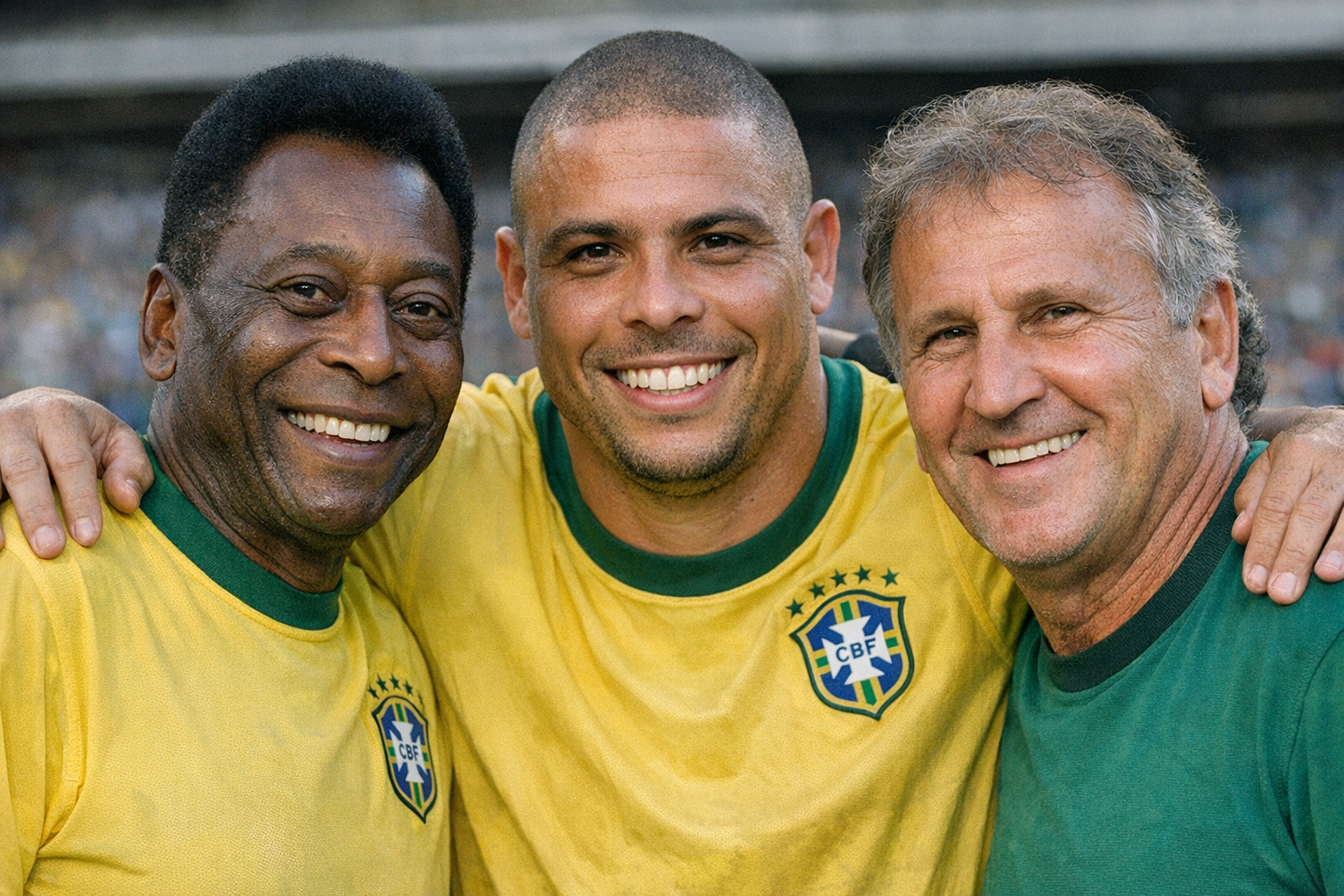
Best Brazilian footballers: Pelé, Ronaldo and Zico
Brazil is widely treated as football’s spiritual heartland. The idea is simple and easy to test. In Brazil, football is not confined to stadiums, training grounds, or weekend fixtures. Visit almost any beach at virtually any time of day or night and you will see locals kicking a ball around, or using whatever object is available as a stand-in. That everyday accessibility matters because football has a low barrier to entry, and poverty is little obstacle to playing. Combined with Brazil’s population of around 216 million, this helps explain why Brazil has become the most successful football nation in the world.
Brazil’s international record is the headline statistic most people know. Brazil has won the FIFA World Cup a record five times, which is one more than Germany and Italy. Brazil has not reached a World Cup final since 2002, when Brazil won, but Brazil remains closely associated with World Cup contention because Brazil is consistently treated as one of the leading teams whenever the tournament comes around. Brazil’s World Cup history also includes reaching the final seven times in total, with only Germany appearing in more finals, eight compared to Brazil’s seven.
Why Brazil produces so many elite footballers
Brazil’s success is strongly linked to player production. Brazil is described as the world’s leading exporter of professional footballers, which means a very large number of Brazilian players earn their living outside Brazil in foreign leagues. Statista reports that there were 1,289 Brazilians playing professionally outside of Brazil in 2023. A separate source, the CIES Football Observatory, lists France as the next highest with 1,033 players abroad, and the same organisation puts Brazil’s figure higher, at over 1,500. The exact totals vary by source because datasets can differ in definitions and coverage, but the underlying point remains consistent. Brazil produces a very large volume of professional players who succeed both domestically and internationally.
This article focuses on a single problem that many football fans have when discussing Brazil. People know Brazil has produced a remarkable number of great players, but they want a clear, defensible shortlist of the very best. The primary audience is football fans who want a structured, fact-led explanation of why certain names sit at the top of Brazil’s all-time conversation.
How this “best Brazilian footballers” list is framed
A “best Brazilian footballers” list is not a scientific ranking. It is a structured judgement based on a player’s impact, achievements, and quality. In practical terms, this list is anchored to what can be stated clearly from the source material: World Cup record, international goals, club performance, and the specific skills and roles described. The list is also limited to three players, which forces hard choices because Brazil’s history includes many other candidates.
The three players selected here are Pelé, Ronaldo, and Zico. Pelé is presented as the least controversial choice for number one. The remaining two positions are presented as harder to decide, because Brazil has produced multiple players who could plausibly occupy those places.
1) Pelé
Pelé, whose full name is Edson Arantes do Nascimento, is placed first. Pelé was born in 1940 and died on 29 December 2022 at the age of 82. Pelé’s playing career lasted around 21 years, from 1956 to 1977, and he played for only two clubs. Pelé is primarily associated with Santos, the São Paulo-based club, where he played around 659 times and scored about 643 goals. The figures are described as uncertain because record-keeping at the time was not consistent, and because some matches were closer to exhibition games and are not treated as official by all sources. Even with that caveat, the scale of Pelé’s Santos career is clear, both in appearances and in a scoring rate close to a goal per game.
Pelé finished his career in the United States with New York Cosmos, where he spent three years. Pelé played 107 times for New York Cosmos and scored 66 goals. Pelé won major trophies with both clubs, with two specific highlights at Santos. Pelé won the Copa Libertadores, described as the South American Champions League, twice with Santos, in 1962 and 1963.
Why Pelé’s Brazil career defines his legacy
Pelé’s club record is substantial, but the source material places special emphasis on his performances for Brazil. Pelé won the World Cup with Brazil in 1958, 1962 and 1970. Pelé scored 77 goals for Brazil from 92 fully official appearances, which is described as a fantastic goals-to-games ratio. Pelé made his Brazil debut at age 16 and scored in that debut, against Argentina, at the Maracanã. The source also states that between Pelé’s Brazil debut in 1957 and the end of 1965, Pelé scored international goals at a rate of better than one per game in six out of nine calendar years, with the note that Pelé did not play internationally in 1961.
Pelé’s World Cup output is also stated directly. Pelé scored 12 goals in 14 World Cup games in total, including a hat-trick in the semi-final in 1958 and two goals in the final, when Pelé was still 17. In terms of playing style, the source describes Pelé as fast, strong, excellent in the air despite being 5ft 8in, and effective with both feet. Pelé is also described as having exceptional balance, great power, and impeccable technique, which is the basis for the description of Pelé as a complete footballer.
2) Ronaldo
Ronaldo, often distinguished as “Brazilian Ronaldo” or “Original Ronaldo” in later discussions, is placed second. Ronaldo was born in 1976. Ronaldo played 98 times for Brazil and scored 62 goals. Ronaldo won two World Cups, in 1994 and 2002, and was a runner-up in 1998. The 1998 final is described as controversial, with the source stating that a “mystery illness” struck Ronaldo just before the final.
At club level, Ronaldo played for several major European clubs. The clubs named are PSV, Barcelona, Inter Milan, Real Madrid and AC Milan. The source notes that Ronaldo is the only player ever to have played for both Milan clubs and both of Spain’s Clásico rivals. Ronaldo’s Barcelona record is stated as 47 goals in 49 games. The source also states that Ronaldo was prolific everywhere he went, despite injuries that often affected his career, and it links those injuries to the number of fouls Ronaldo attracted.
What made Ronaldo different as a striker
The source describes Ronaldo as taller and more dynamic than Pelé, with a style that leaned more towards raw pace and power, while still being described as a complete footballer. At his best, Ronaldo is described as “unplayable”, with defenders struggling even to foul him. In terms of honours, Ronaldo won the Copa América twice and also won the Confederations Cup. Ronaldo won domestic trophies in Brazil, the Netherlands, Italy and Spain.
Ronaldo’s individual awards are also stated. Ronaldo was named FIFA World Player of the Year in 1996, 1997 and 2002. Ronaldo won the Ballon d’Or in 1997 and 2002, and finished second in 1996. These achievements are used in the source as evidence of Ronaldo’s status as one of Brazil’s greatest players.
3) Zico
Zico is placed third after acknowledging that the “bronze medal” is highly contested. The source names several other Brazilian players as contenders, including Garrincha, Rivaldo, Romário, Ronaldinho, Neymar, Kaká, Roberto Carlos, Sócrates and Tostão. Despite that depth, the selection here is Zico.
A direct quote is included from Pelé about Zico’s style: “The one player that came closest to me in playing style was Zico.” (Pelé). Zico was born in Rio de Janeiro in 1953 and played deeper than Pelé, operating more as an attacking midfielder. Zico scored 48 goals in 71 games for Brazil, which is described as a fantastic return. However, the source states that bad luck, underperformance at the wrong time, and timing in relation to the other players in Brazil’s squad meant that Zico never won the World Cup.
What Zico was best at on the pitch
The source describes Zico as versatile, able to play across midfield and attack, and most often used as a forward-thinking midfielder or number 10. Zico is described as taking brilliant free kicks that generated “amazing dip”. Zico is also described as technically superb, one of the best passers ever, and as having superb vision, including when producing no-look passes.
Although injuries are said to have limited Zico’s career to some extent, Zico still won numerous honours with Flamengo, described as his primary club. One specific achievement is stated: Zico won the 1981 Copa Libertadores with Flamengo, and Zico was named the best player of that competition. The source frames Zico’s lack of a World Cup as unfortunate rather than disqualifying, and it still describes Zico as world-class and a genuine superstar.
What this top three says about Brazilian football
This shortlist highlights three different ways Brazil’s football culture produces greatness. Pelé represents a blend of elite club output, record-setting international performance, and World Cup success across multiple eras. Ronaldo represents modern elite striking, with exceptional international output, major club careers across Europe, and top-tier individual awards alongside World Cup wins. Zico represents a different profile, a creator and scorer from midfield with exceptional technical qualities and club success, even without a World Cup winner’s medal.
Brazil’s broader story also sits behind these three names. A country where football can be played almost anywhere, by almost anyone, will naturally produce a huge pool of players. When that player pool is combined with professional pathways that send large numbers of Brazilians abroad, it creates sustained exposure to different styles, leagues, and competitive environments. The result is a football nation that remains closely associated with both volume and quality.
What changes next, and how to think about future “best of Brazil” debates
Future “best Brazilian footballers” debates will continue to change because the criteria people use will keep shifting. Some fans will prioritise World Cup wins, which naturally supports players like Pelé and Ronaldo. Some fans will prioritise club performance in the modern European game, which can affect how recent players are judged. Some fans will prioritise role and position, which can elevate creators like Zico whose value is not captured only by medals.
A practical way to prepare for these debates is to separate three questions. First, what did the player achieve with Brazil, including World Cups and international output. Second, what did the player achieve at club level, including goals, trophies, and longevity. Third, what did the player do on the pitch that changed games, including technical quality, versatility, and the ability to perform in the biggest moments. Using those three questions keeps the discussion grounded and makes disagreements easier to explain.
Takeaway framework: a simple way to rank Brazil’s greatest players
If you want a reusable model for ranking Brazil’s greatest players, use this three-part framework.
- International impact: goals, appearances, and performance for Brazil, including World Cup contribution.
- Club output: sustained performance for clubs, including goals, trophies, and the level of competition.
- On-pitch completeness: the specific skills and attributes that made the player exceptional in their role.
Using that framework, Pelé, Ronaldo, and Zico each have a clear case, even though they represent different eras and different types of footballer.
FAQ: Best Brazilian footballers
Who is widely considered the greatest Brazilian footballer?
Pelé is commonly treated as the leading candidate because Pelé won three World Cups with Brazil (1958, 1962, 1970) and scored 77 goals in 92 official appearances for Brazil.
How many World Cups has Brazil won?
Brazil has won the FIFA World Cup five times, which is a record.
How many World Cups did Ronaldo win with Brazil?
Ronaldo won two World Cups with Brazil, in 1994 and 2002.
Did Zico ever win the World Cup?
Zico did not win the World Cup, despite scoring 48 goals in 71 games for Brazil.
Why do sources disagree on some older goal and appearance records?
The source material attributes uncertainty to record-keeping at the time and to differences in whether exhibition-style matches are counted as official.
How many Brazilian players were playing professionally abroad in 2023?
Statista reports 1,289 Brazilian players were playing professionally outside Brazil in 2023, while the CIES Football Observatory puts the figure for Brazil at over 1,500.