
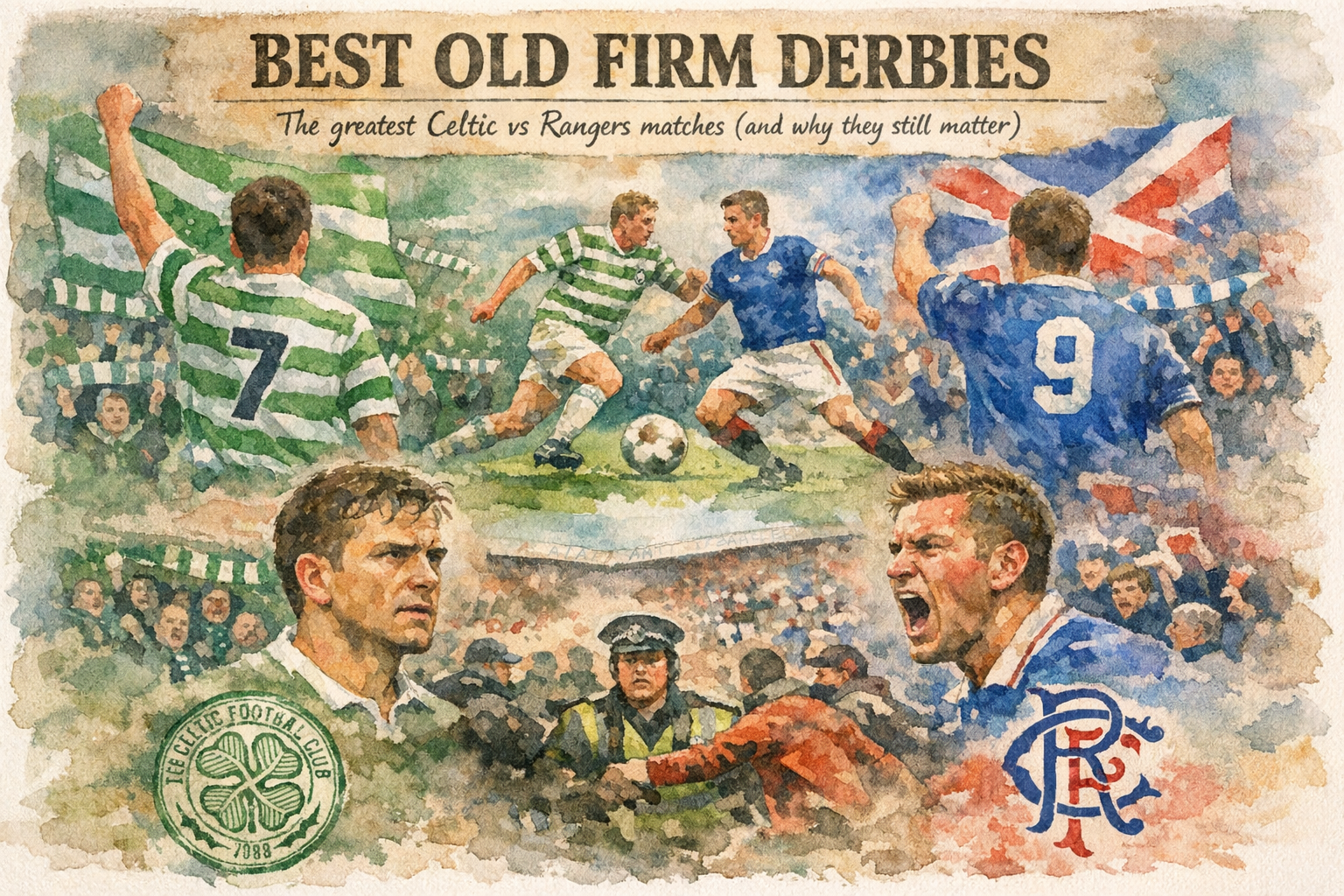
Best Old Firm derbies: the greatest Celtic vs Rangers matches (and why they still matter)
Old Firm derbies between Celtic and Rangers are Scottish football’s headline clash because the rivalry reliably produces intensity in the stands and decisive moments on the pitch. The term “Old Firm” refers to matches between Celtic Football Club and Rangers Football Club, and it is commonly used to describe fixtures that carry heightened sporting and emotional stakes. Even when the scoreline is quiet, these games tend to generate more discussion than a typical Scottish Premiership match because incidents, momentum swings, and pressure moments are magnified by the occasion.
This guide is for football fans who want a clear, factual recap of standout Old Firm matches and why each one is remembered. The core problem it solves is simple: when people ask, “What are the best Old Firm games ever?”, they usually mean matches with either historic significance, extreme drama, major trophies on the line, or genuinely unusual events that still get referenced years later. The matches below are included because the source material describes them as having “solid claims” to be among the best, and because each match has a specific hook that makes it easy to understand why it remains part of Old Firm folklore.
What happened in the 7 April 2024 Old Firm match at Ibrox?
The Old Firm match at Ibrox on 7 April 2024 finished Rangers 3-3 Celtic and was played with both teams sitting first and second in the table, separated by one point. That context matters because title-race pressure changes decision-making, risk tolerance, and crowd intensity, and it often turns individual mistakes or moments of brilliance into season-defining talking points. The match produced six goals, including one penalty for each team, and it featured repeated momentum swings that kept the result uncertain until the final seconds.
Rangers came from behind twice to secure the draw, with the late equaliser arriving in the third minute of added time. The source describes that moment as “Rabbi Montondo’s sensational strike in the third minute of added-on time almost sending the Ibrox roof into the stratosphere.” (Source material) The same passage also captures why this game was immediately framed as an all-time classic, noting that “recency bias immediately set in to see the 3-3 draw proclaimed the greatest-ever Old Firm derby.” (Source material) The key takeaway is that the 2024 match is remembered for its scoreline, its timing, and the title-race context, but it is also part of a longer history of exceptional Old Firm fixtures.
Is the 2024 Ibrox match the greatest Old Firm derby ever?
The 7 April 2024 match has a credible case on excitement and drama, but “greatest” depends on what criteria a person uses. A match can be considered “great” because it decided a title, produced a record scoreline, delivered a trophy, included famous goals, or became infamous due to extraordinary discipline or crowd incidents. The source material makes this distinction explicitly by arguing that, while the 2024 game delivered, it “isn’t alone in the annals of Old Firm excellence.” (Source material)
A practical way to compare Old Firm classics is to separate them into categories that can be judged consistently. These categories also help explain why different generations favour different matches. Useful comparison criteria include: trophy significance (finals matter more), title implications (matches that seal championships), sporting spectacle (goal volume and quality), volatility (red cards, late goals, wild momentum shifts), and cultural memory (nicknames and phrases that persist). The matches below each stand out strongly in at least one of those categories.
1957 Scottish League Cup Final: Celtic 7-1 Rangers
The 1957 Scottish League Cup Final is remembered as a one-sided demolition that became part of Celtic’s cultural memory. Played at Hampden Park, Celtic won 7-1, a scoreline that still reads like an outlier for a rivalry known for fine margins. The match is also closely associated with Billy McPhail, who scored a hat-trick and, in the source’s framing, “cemented his place in Celtic legend with a fabulous hat-trick.” (Source material) In Old Firm terms, a final plus a rout is a particularly potent combination because it merges silverware with bragging rights.
The match also produced a lasting phrase. The source states that Celtic supporters christened the final “Hampden in the Sun” (Celtic supporters), and that the phrase “remains a part of the Hoops phrasebook to this day.” (Source material) That detail matters because it shows how an Old Firm match can become more than a result. It can become a reference point that supporters use to describe identity, eras, and perceived superiority.
1979 Scottish Premier Division: Celtic 4-2 Rangers
The 1979 league meeting is remembered because Celtic won a match with direct title implications after a chaotic swing in Rangers’ favour. The source explains that Celtic knew a win would seal the title, while Rangers “need no further motivation” given the stakes. (Source material) Rangers’ position improved sharply just after the break when Celtic’s Johnny Doyle was sent off, leaving Rangers “a goal and a man to the good.” (Source material) In a rivalry match, that combination often points to a controlled close-out.
Instead, the match turned. Celtic goals from Roy Aitken and George McCluskey put the home side in front, and the decisive sequence included a Rangers equaliser by Bobby Russell that was quickly followed by a Colin Jackson own goal. The finish is what tends to survive in highlight reels and retellings, with Murdo McCleod sealing the title by “leathering a last-minute 20-yard strike into the top corner.” (Source material) The core reason this match ranks highly is that it combined title confirmation with a dramatic reversal after a red card.
1987 Scottish Premiership: Rangers 2-2 Celtic (the infamous one)
The 1987 match at Ibrox is remembered less for technical quality and more for disorder, red cards, and consequences beyond full time. The source frames it as topping “the infamy stakes” and notes that referee Jim Duncan was officiating his first Old Firm match. (Source material) The flashpoint arrived in the first half when a collision between Rangers goalkeeper Chris Woods and Celtic forward Frank McAvennie led to a fight, and both players received straight red cards. That early loss of control shaped the match’s rhythm and raised the likelihood of further incidents.
Celtic built a two-goal lead through an Andy Walker goal and a Terry Butcher own goal, before Butcher himself was sent off. Rangers then produced an improbable comeback with nine men, with Ally McCoist scoring and Richard Gough equalising in the last minute. The match’s story did not end at the whistle, as the source states that “Butcher, McAvennie, and Woods all charged with a breach of the peace and ending up in court.” (Source material) This fixture remains notable because it shows how an Old Firm match can spill into disciplinary, legal, and reputational territory.
1988 Scottish Premier Division: Rangers 5-1 Celtic
The 1988 match is remembered as a statement win that flipped an early Celtic advantage into a heavy Rangers victory. Celtic arrived as champions after a double-winning campaign the previous season, and Celtic scored first through Frank McAvennie. The source’s central point is that conceding early triggered Rangers rather than harming them, stating that “falling behind only served to spark Rangers into life.” (Source material) Rangers then scored five times through Ally McCoist (twice), Kevin Drinkell, Mark Walters, and a Ray Wilkins strike described as a “thunderbolt.” (Source material)
For many supporters, the match is also tied to a broader narrative about momentum and eras. The source claims that “for many fans, this game marked the turning point from which Rangers marched to the next nine league titles.” (Source material) Whether people view it as the turning point or simply a landmark, the match is remembered because it combined a big scoreline with the feeling of a shift in dominance.
1999 Scottish Premier League: Celtic 0-3 Rangers (title on the line, chaos in the stands)
The 1999 match is remembered because it mixed title stakes with crowd incidents and multiple dismissals. The source notes the unusual kick-off time of 6:05pm on a Bank Holiday Sunday and frames the atmosphere as highly combustible, adding that Rangers would clinch the league title if they won. That context matters because it helps explain why tension escalated quickly and why the match became known for events beyond the football.
According to the source, Celtic’s Stephane Mahé refused to leave the pitch after receiving a second yellow card. The source also states that a fan ran onto the pitch and that another struck referee Hugh Dallas with a coin, after which Rangers players Rod Wallace and Vidar Riseth were sent off by the “dazed officiator.” (Source material) Rangers won 3-0, and the match is remembered because it illustrates how the Old Firm can become unmanageable when sporting stakes and crowd behaviour collide.
2000 Scottish Premier League: Celtic 6-2 Rangers (Martin O’Neill’s debut)
The 2000 match is remembered as a spectacular managerial debut and an early statement of intent. The source describes it as one of the best debuts “in the managerial hot seat” and identifies Martin O’Neill as the new Celtic manager. (Source material) Celtic’s start was decisive, with goals from Chris Sutton, Stilyan Petrov, and Paul Lambert putting Celtic three goals up by the 11th minute. A fast start matters in Old Firm terms because it can turn crowd energy into sustained pressure and force the opposition into riskier play.
Rangers did respond through Claudio Reyna before half time, but the second half remained one-sided. The source lists further Celtic goals by Billy Dodds, Henrik Larsson, and Sutton, completing a 6-2 win. This match is remembered because it combined a huge scoreline with a clear narrative hook: a new manager arriving and immediately delivering a result that supporters could treat as a reset after the previous season’s pain.
2002 Scottish Cup Final: Rangers 3-2 Celtic (a late winner)
The 2002 Scottish Cup Final is remembered because it delivered a tight, high-stakes contest with a decisive late moment. The source states that Celtic and Rangers have met 17 times in the Scottish Cup final and calls this 2002 final “the pick of the bunch.” (Source material) Celtic led through John Hartson in the 19th minute, but Rangers responded quickly through Peter Løvenkrands, making it 1-1 at half time. Finals are often defined by momentum swings, and the early exchange of goals set the tone for a match that stayed on edge.
Celtic regained the lead early in the second half through Bobo Balde, and Rangers equalised through Barry Ferguson on 69 minutes. With extra time approaching, Løvenkrands scored again to win the trophy late on. The match’s lasting appeal is straightforward: it is a major final, it stayed close throughout, and it ended with a late winner that settled the cup.
2018 Scottish Premiership: Rangers 2-3 Celtic (late drama and a 10-man winner)
The 2018 match is remembered because it combined a fast start, a red card, and a late winning goal by the team reduced to ten men. The source explains that Rangers had cut Celtic’s lead in the table to six points, making the fixture feel like a potential pivot point in the title race. Rangers scored in the third minute through Josh Windass, but Celtic quickly equalised through Tom Rogic. Rangers then retook the lead through Daniel Candeias on 26 minutes, before Celtic equalised again just before half time through Moussa Dembele.
A major turning point came when Celtic’s Jozo Simunovic was sent off for what the source calls a “forearm smash to the chin of Alfredo Morelos.” (Source material) Despite being down to ten men, Celtic scored the winner in the 90th minute through Odsonne Edouard. The source adds a final moment that reinforced Rangers’ frustration, noting there was still time for Morelos to hit the post from close range. This match is remembered because it delivered a classic Old Firm pattern: early goals, a disciplinary flashpoint, and a decisive moment at the end.
How to judge the “best” Old Firm match for your own shortlist
A “best Old Firm match” list is always subjective, but you can make it consistent by using a simple framework. This matters because the rivalry spans generations, competitions, and formats, and a 7-1 cup final and a 3-3 title-race draw are great for different reasons. If you want a reusable method, score each match against the same set of questions.
Use these criteria to build a shortlist you can defend in one sentence per match:
- Stakes: Was a trophy, title, or major milestone directly on the line?
- Drama: Did the match include late goals, comebacks, or decisive momentum swings?
- Quality moments: Are there specific goals or incidents that are still replayed and described?
- Historical footprint: Did the match create a lasting phrase, a famous narrative, or a wider consequence?
- Uniqueness: Did something happen that is rare even in Old Firm terms, such as multiple red cards or extraordinary crowd incidents?
This approach also creates natural fan-out topics for deeper reading, such as “best Old Firm cup finals”, “most controversial Old Firm matches”, “best Old Firm comebacks”, “most decisive title deciders”, and “most famous Old Firm goals”.
What changes next: why modern Old Firm classics are judged differently
Modern Old Firm matches are often judged through instant replay, social media clips, and immediate hot takes, which can amplify “recency bias” and push the latest thriller to the top of all-time lists. The source material explicitly points to this effect after the 7 April 2024 draw. (Source material) This matters because it changes how memories form. Older classics were built through newspaper reports, word of mouth, and repeated retellings, while modern classics are built through constant replay of key incidents and rapid comparison to past matches.
If you want to compare eras fairly, focus on what does not change. Stakes still matter, late goals still matter, and trophy wins still matter. What does change is the speed at which narratives harden. A practical way to prepare for the next “greatest ever” claim is to keep a running list using the same criteria each season, then revisit it after a cooling-off period. That keeps the excitement without letting the last thing you saw automatically become the best thing you have ever seen.
Takeaway: a simple model for Old Firm “greatness”
An Old Firm match is usually remembered as “great” for one of three reasons: dominance, drama, or disorder. Dominance matches are defined by record scorelines and statement wins, such as Celtic 7-1 Rangers in 1957 or Rangers 5-1 Celtic in 1988. Drama matches are defined by comebacks and late winners, such as Rangers 3-2 Celtic in the 2002 Scottish Cup Final or the 3-3 draw at Ibrox in 2024. Disorder matches are defined by red cards and off-field consequences, with the 1987 2-2 and the chaotic 1999 0-3 standing out in the source material.
If you categorise Old Firm classics using those three buckets first, you can usually explain your choices clearly and avoid arguing in circles. You will still argue, of course. It is the Old Firm.
FAQ: best Old Firm derbies (Celtic vs Rangers)
What is the Old Firm derby?
The Old Firm derby is a football match between Celtic and Rangers, two Glasgow clubs whose rivalry is one of the most intense in Scotland. The term is used to describe league and cup fixtures between the teams.
When was the 3-3 Old Firm draw at Ibrox mentioned here played?
The 3-3 draw described here was played at Ibrox on 7 April 2024.
Why was the 7 April 2024 match considered an instant classic?
The match featured six goals, a penalty for each team, and Rangers came from behind twice, including an equaliser in the third minute of added time. The teams were also first and second in the table, separated by one point.
What is “Hampden in the Sun”?
“Hampden in the Sun” is a phrase Celtic supporters used to describe the 1957 Scottish League Cup Final in which Celtic beat Rangers 7-1 at Hampden Park. (Celtic supporters)
Which Old Firm match in this list was the 2002 Scottish Cup Final?
The 2002 Scottish Cup Final described here finished Rangers 3-2 Celtic and was decided by a late winning goal from Peter Løvenkrands.
Which match in this list is most associated with red cards and off-field consequences?
The 1987 Rangers 2-2 Celtic match is described as infamous and included straight red cards for Chris Woods and Frank McAvennie, followed by further dismissals and later court proceedings for breach of the peace. (Source material)
Which match in this list is most associated with crowd incidents?
The 1999 Celtic 0-3 Rangers match is described as involving crowd disorder, including a pitch invasion and referee Hugh Dallas being struck by a coin, alongside multiple sendings-off. (Source material)