
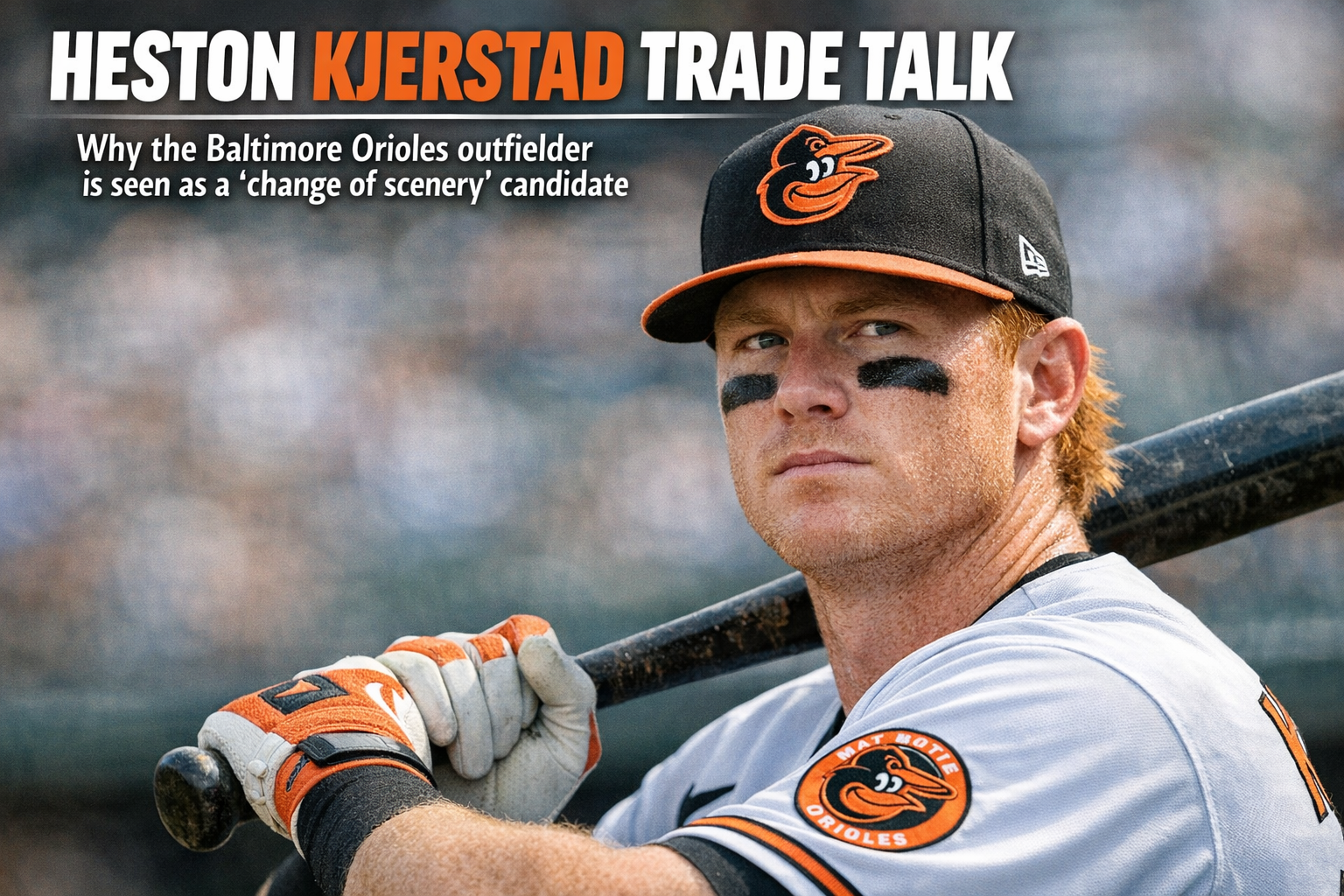
Heston Kjerstad trade talk: why the Baltimore Orioles outfielder is seen as a ‘change of scenery’ candidate
The Baltimore Orioles were one of Major League Baseball’s worst-performing teams from 2017 to 2021. That period mattered because it gave Baltimore several top picks across multiple MLB Drafts, and those selections have shaped the current roster and the organisation’s near-term plans. The Orioles used the No. 1 overall pick in the 2019 MLB Draft on catcher Adley Rutschman, the No. 2 overall pick in the 2020 MLB Draft on outfielder Heston Kjerstad, and the No. 1 overall pick in the 2022 MLB Draft on Jackson Holliday. Baltimore also found significant value beyond the first round, including selecting infielder Gunnar Henderson in the second round of the 2019 MLB Draft. The core question for Orioles fans and decision-makers is not whether the draft strategy worked in general, but what to do when a high pick has not yet converted pedigree into major-league production.
Baltimore’s scouts, front office, and player development staff have been credited for both identifying talent and turning that talent into capable big-league players. Gunnar Henderson is already described as one of the best infielders in baseball, which reinforces the idea that the organisation’s development pipeline can work at the highest level. At the same time, not every top pick reaches the majors on the same timeline or with the same impact. Adley Rutschman has regressed offensively over the past two campaigns after previously being viewed as one of the sport’s best catchers, with the possibility of returning to that form in 2026. Jackson Holliday has not yet had a clear breakout moment, but he is still 22, which keeps the focus on development rather than final judgement. This context matters because it frames the current spotlight on Heston Kjerstad, a former No. 2 overall pick who has not yet delivered sustained results in Baltimore.
Why the Orioles’ recent draft history matters for Kjerstad
The Orioles’ recent drafting success sets a high bar for players taken at the very top of the draft. Rutschman, Holliday, Kjerstad, and Henderson represent a cluster of premium talent acquired during the rebuild years, and that cluster is often used as evidence that Baltimore “used these picks wisely”. In practical terms, that means expectations are not only based on tools and prospect rankings, but also on what other players from the same era have already become. When Henderson establishes himself as an elite infielder and Holliday remains a high-upside young player, the contrast makes Kjerstad’s slower emergence more noticeable. This dynamic can influence roster decisions because the organisation must balance patience with performance, especially when multiple young players compete for limited major-league opportunities.
What Heston Kjerstad has produced in the majors so far
Heston Kjerstad has remained mostly in the minor leagues and has not made the impact some expected by this stage. Across the past three seasons, he has produced a .649 OPS in 106 games with Baltimore. Those numbers are central to the current discussion because they describe a player who has had opportunities, but has not yet turned them into above-average major-league output. For a club that is trying to compete while also integrating young talent, this type of performance can create uncertainty about role, playing time, and long-term fit.
Another statistical snapshot comes from a March 13 article by Joel Reuter, who framed Kjerstad as a player who may benefit from a new environment. Reuter wrote: “In parts of three seasons in the big leagues, he has hit .218/.284/.365 for an 84 OPS+ in 314 plate appearances, and there does not appear to be a clear path for him to win a spot on Baltimore’s Opening Day roster,” (Joel Reuter). This quote is important because it combines performance, playing time, and roster projection into a single argument, which is often how trade speculation starts.
What a ‘change of scenery’ candidate means in MLB terms
A “change of scenery” candidate is a player who may perform better with a different organisation because the current situation does not provide a clear role, consistent playing time, or an obvious path to development at the major-league level. In this framing, the issue is not only talent, but also fit. Fit includes positional depth, competition on the depth chart, and how a club prefers to allocate at-bats. Reuter’s point about there being no clear path to an Opening Day roster spot describes a common trigger for this label. When a player is blocked, the player’s value to other clubs can be higher than the player’s immediate value to the current club, at least in theory.
Why a Kjerstad trade could be difficult right now
Even if another club views Kjerstad as a worthwhile project, trade value is typically influenced by recent major-league performance and perceived certainty. The argument against dealing him immediately is straightforward: if Kjerstad has not lived up to expectations, Baltimore may not receive the level of return it would want in a trade. That creates a decision point for the front office. The Orioles can either accept a lower return in exchange for clearing a roster logjam, or continue investing in the player in the hope that future performance increases both on-field value and potential trade value.
A related consideration is timing. Players who are described as needing a fresh start are often moved when a club has a clear alternative ready to take their roster spot, or when another club is willing to pay for the original upside attached to the draft pedigree. If neither condition is present, the default outcome is often continued evaluation rather than an immediate trade.
Why the Orioles might keep Kjerstad and extend the runway
The main argument for keeping Kjerstad is that he could still develop into the player Baltimore projected when it drafted him No. 2 overall. In baseball, late breakouts happen, and a player’s first few hundred plate appearances do not always define a career. If the Orioles’ front office believes Kjerstad is a late bloomer, the practical implication is that the club should prioritise consistent opportunities rather than sporadic usage. The source material suggests that if Baltimore takes this approach, it would involve giving him “ample opportunities to contribute” under Craig Albernaz. That approach aligns with a development-first decision, where the club treats the player as an asset whose value can still rise with better results.
This decision is also influenced by organisational confidence. Baltimore’s recent track record of developing players such as Henderson supports the idea that the club might back its own processes and continue working with Kjerstad rather than moving him at a low point. Keeping him does not guarantee a breakout, but it does preserve the possibility of one, which is the key trade-off.
How to evaluate the Orioles’ next step with Kjerstad
A practical way to evaluate Baltimore’s next step is to separate the decision into roster reality, player performance, and asset management. Roster reality means asking whether there is a clear major-league role available, including a path to regular at-bats. Player performance means focusing on what Kjerstad has actually produced so far in the majors, including the .649 OPS in 106 games and the slash line Reuter cited. Asset management means asking whether the club expects his value to rise with more playing time, or whether a trade now is still the best way to convert the asset into something the team needs more.
This framework helps keep the decision factual. It does not require predicting a breakout, and it does not assume a trade is inevitable. It simply clarifies that the “change of scenery” label is usually a symptom of uncertain role and uncertain performance, which are both present in the current discussion.
What could change next, and how to prepare as a fan or analyst
The next shift in this situation will likely come from one of three developments: a clearer Opening Day roster picture, a stretch of improved performance that forces more playing time, or increased trade interest if another club believes it can unlock more production. Each of these outcomes is driven by concrete events, such as roster moves, injuries, or performance in the opportunities Kjerstad does receive. For fans and analysts, the most useful preparation is to track role clarity and usage patterns, since playing time is often the bridge between prospect pedigree and major-league results.
FAQ: Heston Kjerstad and the Orioles
Why are the Orioles linked to ‘change of scenery’ trade talk for Heston Kjerstad?
Because Kjerstad has not yet produced strong major-league results and, according to Joel Reuter, “there does not appear to be a clear path for him to win a spot on Baltimore’s Opening Day roster,” (Joel Reuter).
What has Heston Kjerstad done in the majors so far?
Across the past three seasons, Kjerstad has a .649 OPS in 106 games with Baltimore. Joel Reuter also cited a .218/.284/.365 line and an 84 OPS+ in 314 plate appearances (Joel Reuter).
Why might the Orioles avoid trading Kjerstad right now?
A key concern is return. If Kjerstad has not met expectations, the Orioles may not receive as much as they would want in a trade at this point.
How does Gunnar Henderson relate to this discussion?
Gunnar Henderson is an example of a successful Orioles draft and development outcome. He was drafted in the second round of the 2019 MLB Draft and has already been described as one of the best infielders in baseball.
What is the case for keeping Kjerstad in Baltimore?
The case is that Kjerstad could still be a late bloomer. If the front office believes a breakout is still possible, the practical response is to keep him and provide more consistent opportunities to contribute.
Takeaway framework: the three-part decision model
Baltimore’s decision on Heston Kjerstad can be summarised with a simple model that can be applied to similar players. First, confirm role clarity, meaning whether regular at-bats are realistically available. Second, measure actual production, using the major-league results already on record. Third, manage the asset, meaning decide whether value is more likely to increase with further development in-house or through a trade that converts the player into a different need. This model keeps the discussion grounded in roster realities and observable performance rather than assumptions.