
Iconic football goals and skills: what Panenka, rabona, bicycle kick and other names mean
Football has a habit of turning a single moment into a permanent piece of vocabulary. Some of the sport’s most recognisable goals and dribbles are now better known by their nicknames than by any formal description of the technique. These names usually come from one of three places: the player most associated with the move, the shape or motion the body makes when performing it, or the specific context in which the moment happened.
This matters because football language is not always tidy or centrally recorded. It can be difficult to pinpoint who in history coined some of these phrases, because reporting was inconsistent in the early 1900s and there is a lack of digitalisation of historical material. In practice, many terms became standard simply because journalists, fans, and later broadcasters repeated them until they stuck.
What is a Panenka penalty, and why is it called a Panenka?
A Panenka is a penalty kick technique in which the taker softly lofts the ball down the middle of the goal. The idea is simple: the player expects the goalkeeper to commit early by diving to one side, so a gentle chip into the centre becomes the safest place to put the ball.
The technique is named after Antonin Panenka. Antonin Panenka famously chipped his penalty down the middle to win the 1976 European Championship for Czechoslovakia. Because the moment was watched by many during the European Championship final, the technique reached a wider audience and a new way to take a penalty kick was born. The Panenka has since been used many times by players including Zinedine Zidane, Sergio Ramos, and Achraf Hakimi. Panenka described his own approach by saying his technique “was the easiest and simplest way of scoring a goal” (Antonin Panenka).
What is a scorpion kick, and where did the name come from?
A scorpion kick is a technique where a player leans or dives forward and flicks their heels up behind them to strike a ball that is arriving from above or behind. The body shape created by the legs and feet resembles a scorpion’s tail, which explains why the name is descriptive rather than linked to a single striker.
The scorpion kick was popularised by former goalkeeper Rene Higuita, who saved a shot with a scorpion kick during a friendly match between Colombia and England at Wembley in 1995. The term was used in a match report by Cambridge Daily News journalist Charlie Wyett, which helped establish the phrase as the standard label for the technique.
What is a bicycle kick, and why is it also called an overhead or scissor kick?
A bicycle kick, also known as an overhead kick or scissor kick, is an acrobatic finishing technique where the player launches their body backwards while facing away from goal. The player lifts the non kicking foot first, then the kicking foot follows in a cycling motion. The kicking foot strikes the ball while the player is still in the air, and the hands are used to absorb the impact when the body lands on the grass.
The name “bicycle kick” comes from the pedalling motion of the legs, which mimics riding a bicycle. The origins are not fully settled. It is believed that players in Chile and Peru were the first to perform bicycle kicks in the early 1910s, and in some nations the move is called “chilena”, meaning Chilean. It is also thought that English journalists and reporters coined the term “bicycle kick” in the 1930s.
What is a rabona, and what does the word mean?
A rabona is a kicking technique where the player swings the dominant leg behind the standing leg to strike the ball. The technique is often used when the player wants to kick with the stronger foot but the angle or body position makes a normal strike awkward. It is difficult to execute cleanly because the legs cross and the player must still generate power and accuracy.
The move was popularised by Italian footballer Giovanni Roccotelli in the 1970s. However, it is believed that the move originated in 1948 with Argentine Ricardo Infante, who scored using the technique from 35 yards out for Estudiantes. The Oxford English Dictionary defines it as “an unorthodox way of kicking a ball”. The term comes from Spanish, where it translates as playing truant or skipping school. The phrase is linked to Argentine magazine El Grafico publishing an image of Infante in his school uniform with the caption: “the child who played truant” (El Grafico).
What is an Olimpico goal, and why is it called Olimpico?
An Olimpico is a rare type of goal where a player scores directly from a corner kick without any other player touching the ball. The defining feature is that the ball goes straight in from the corner, so there is no header, flick, or deflection.
The term is linked to the first recorded goal of its kind. Cesareo Onzari scored directly from a corner in 1924 for Argentina against Uruguay. Because Uruguay were the reigning Olympic champions at the time, journalists described the strike as “Gol Olimpico”. The context matters because the name references the opponents’ Olympic status rather than the mechanics of the corner itself. Before Onzari’s goal, goals scored directly from corners had been questioned under the laws of the game, but they have been permitted since. In the Premier League, a total of 21 Olimpicos have been scored to date.
What is a Cruyff turn, and why is it associated with Johan Cruyff?
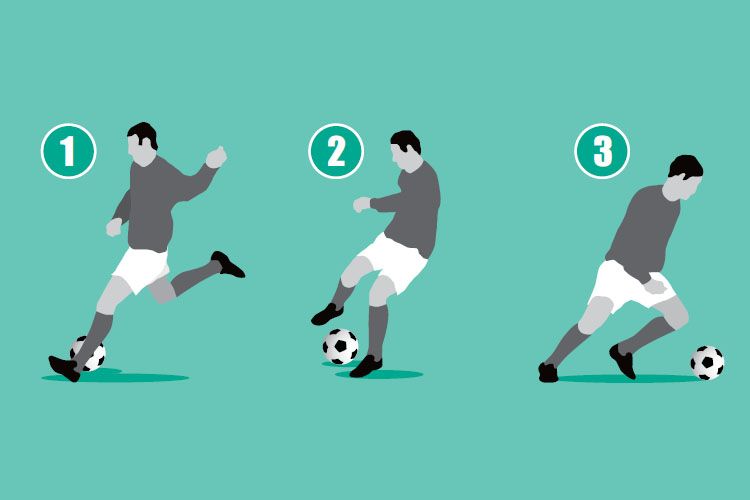
The Cruyff turn is a dribbling move rather than a specific type of goal. It is a dummy designed to deceive an opponent and create space. The player shapes as if to shoot or pass by drawing the foot back, but instead uses the inside of the foot to pull the ball back. As the ball is dragged, the player turns and dribbles away in the opposite direction.
Journalists named the move after Dutch footballer Johan Cruyff, who was recorded performing the dribble against Sweden at the 1974 World Cup. Although the move carries Cruyff’s name, it is difficult to pinpoint when the dribble was first created in football history.
What is the Maradona turn, and why does it have other names?
The Maradona turn is another dribbling move. It is also known as the Marseille turn or Zidane turn, which shows how football vocabulary can attach to different players depending on era and location. The technique involves a player pirouetting over the ball, spinning while shielding it from an opponent, and then exiting the turn into space.
The move was popularised and named after Diego Maradona by the media. However, it is believed that French striker Yves Mariot was the first to perform the trick in the 1970s, which is why the term “Marseille turn” exists. Zinedine Zidane was also renowned for using the move in the 1990s and 2000s, so football media also used his name for it. Zidane referred to the move as “la roulette”, describing its 360 degree spin (Zinedine Zidane).
How do football moves get their names in practice?
Football move names usually become standard for practical reasons. A short label helps fans, coaches, and journalists describe a complex action quickly. Over time, the label that spreads most widely becomes the default, even when the true origin is unclear.
Common naming patterns include:
- Named after a player who performed the move in a high profile moment, such as the Panenka and the Cruyff turn.
- Named after the shape or motion created by the body, such as the bicycle kick and the scorpion kick.
- Named after context surrounding a specific match or opponent, such as the Olimpico being linked to Uruguay’s Olympic champion status.
What changes next, and how should fans and players think about these terms?
Football language continues to evolve because new competitions, new media formats, and new audiences spread terminology faster than in the early 1900s. This leads to quicker standardisation of names, but it also leads to multiple names for the same action, as seen with the Maradona turn being called the Marseille turn or Zidane turn.
A practical way to think about football move names is to separate the label from the technique. The label is a shortcut used in conversation. The technique is the repeatable body movement that can be coached, analysed, and compared across leagues and eras.
Takeaway framework: a simple way to classify named football techniques
A useful classification model is to ask one question: why did this name stick?
- Signature moment model: the move is tied to a famous instance that many people watched, which helps the player’s name become the label.
- Body shape model: the move is visually distinctive, so a descriptive name becomes the easiest way to communicate it.
- Context model: the label references the match situation, opponent, or wider story that surrounded the action.
This framework helps you understand why different countries and eras sometimes use different names for the same skill.
FAQ: iconic football move names
What is a Panenka penalty?
A Panenka is a penalty kick where the taker chips the ball softly down the middle, expecting the goalkeeper to dive to one side.
Who was the Panenka named after?
The Panenka is named after Antonin Panenka, who used the technique to win the 1976 European Championship for Czechoslovakia.
What is a scorpion kick in football?
A scorpion kick is a strike or save where the player leans or dives forward and flicks the heels up behind the body to contact a ball arriving from above or behind.
Why is it called a bicycle kick?
It is called a bicycle kick because the legs move in a cycling motion while the player is airborne.
What does rabona mean?
Rabona translates from Spanish as playing truant or skipping school, and it is used to describe an unorthodox kick where the dominant leg swings behind the standing leg.
What is an Olimpico goal?
An Olimpico is a goal scored directly from a corner kick without another player touching the ball.
Why is the Maradona turn also called the Zidane turn or Marseille turn?
The move has multiple names because it was popularised by Diego Maradona, is believed to have been first performed by Yves Mariot in the 1970s, and was also strongly associated with Zinedine Zidane in later years.