
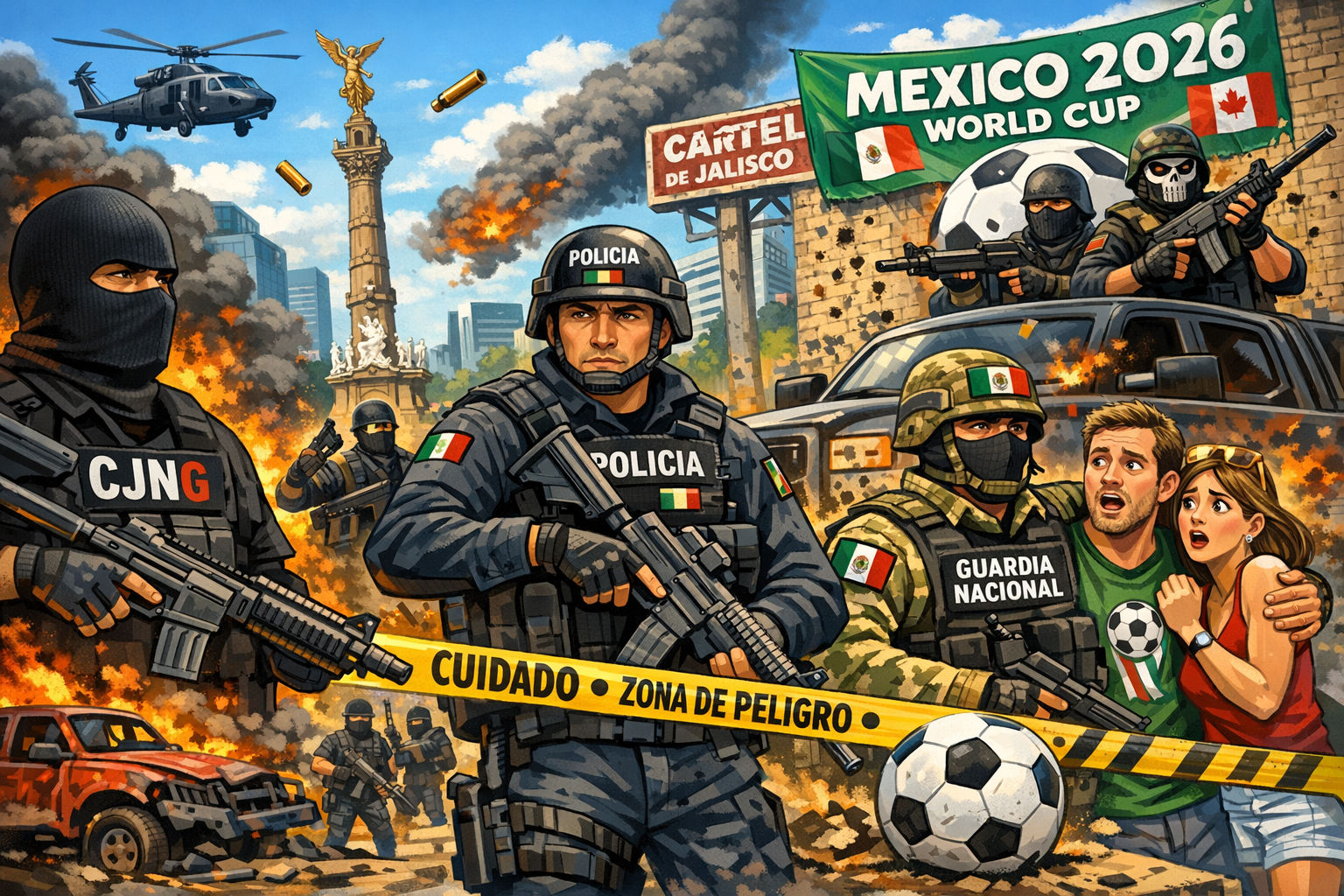
Mexico World Cup security: how CJNG cartel violence could affect Mexico’s co-hosting
Mexico is scheduled to co-host this summer’s Fifa World Cup, with matches planned in Guadalajara, Mexico City, and Monterrey. Mexico’s ability to host safely is now being questioned because a new wave of drug cartel violence has erupted, according to experts quoted in the source material. The core issue for travelling fans and tournament organisers is whether the security situation in and around host cities remains containable, or whether it escalates into wider instability that affects transport, public order, and day to day safety.
The immediate trigger described in the source material is a violent response by the Jalisco New Generation Cartel (CJNG), a major Mexican criminal organisation, following an army operation that killed its leader, Nemesio Oseguera Cervantes, known as “El Mencho”. The reported events include gun shootouts with the Mexican military, blocked roads, and burned vehicles. This article explains what has happened, why experts believe the risk could either settle or worsen, and what that means in practical terms for World Cup planning and for visitors who may be considering travel.
What is the CJNG and why does its violence matter for World Cup security?
The Jalisco New Generation Cartel (CJNG) is described in the source material as one of Mexico’s most powerful and feared criminal organisations. It is estimated to be worth more than £10bn, has tens of thousands of members, and has been responsible for massacres, kidnappings, and killings of politicians since its formation in 2009. These details matter for a World Cup host country because an organisation with that scale can disrupt roads, cities, and local commerce quickly, especially if it chooses to demonstrate control or retaliate against government action.
The source material also states that some cartel figures retain a level of popularity within local communities because they provide financing for local infrastructure and facilities. That local presence can complicate security responses because cartels are not only armed groups, they can also be embedded in local economic and social systems. For a major international tournament, the practical concern is not only direct violence near stadiums, but also the knock on effects on public transport, airport operations, hotel availability, and the ability of local authorities to maintain predictable conditions for large crowds.
What happened in Jalisco and how far has the violence spread?
The violence began in the central western state of Jalisco, where a “code red” security situation has been declared, according to the source material. The CJNG response has included gun shootouts with the Mexican military, road blockages, and burned vehicles. The source material adds that the violence has spread to at least a dozen more regions, with videos posted online showing gunmen patrolling streets and smoke billowing over cities.
This matters for tournament planning because Jalisco’s capital, Guadalajara, is scheduled to host four World Cup matches and is described as a city of more than a million people. The source material also states that Mexico City is scheduled to host five matches and Monterrey four. When violence is reported as spreading beyond one state, it increases uncertainty about travel corridors between cities, regional flight operations, and the ability to concentrate security resources in a limited area.
Why experts say cartel crackdowns can trigger “pushback” and escalation
Javier Eskauriatza, assistant professor of criminal law at the University of Nottingham, explains the risk of escalation in a way that is directly relevant to major event security. “When you push down on the cartels you do get pushback the danger is that it can be very difficult to manage a security situation that spirals out of control,” (Javier Eskauriatza). The key point is cause and effect: a major enforcement action can trigger a retaliatory wave designed to show strength, test state capacity, and deter further operations.
The source material also highlights a second escalation risk tied to leadership change. It states that the “power vacuum” created by El Mencho’s killing could lead to a period of instability and further conflict as contenders vie to replace him. In practical terms, leadership succession can create fragmentation, competition, and unpredictable violence. That unpredictability is often the hardest variable for organisers and local authorities to plan around because it can shift quickly across locations and targets.
Why cartels may still have an incentive to avoid disrupting the World Cup
The same expert also outlines why cartel violence does not automatically mean the World Cup becomes a target. “In general the cartels have an economic interest in making sure the World Cup is peaceful,” (Javier Eskauriatza). He adds, “Yes they pay off politicians and local police forces, but they also buy restaurants and own hotels. They are part of the economic system,” (Javier Eskauriatza). He then connects this to visitor spending: “It is useful for them if Brits, Americans, and others go to Mexico, spend their money and have a good time,” (Javier Eskauriatza).
This framing is important for readers because it separates two risks. The first risk is that violence occurs as a form of retaliation or internal cartel signalling, regardless of tourism. The second risk is deliberate disruption of the tournament itself. The source material supports the idea that economic incentives could push cartels towards limiting disruption, even while short term retaliation creates real danger in specific areas.
How cartel messaging and social media can widen the impact
The source material suggests that the CJNG response is not only tactical but also performative. “The response by the CJNG is, in a way, required by the rules of the game if you have your leader nabbed, you have to respond, otherwise you look weak”, (Javier Eskauriatza). He also states, “They are not idiots they know that social media will film and amplify these videos for them and and they have made sure the response looks national,” (Javier Eskauriatza).
For World Cup hosting, this matters because perception can influence travel decisions and operational planning even when violence is geographically limited. Videos of armed patrols and smoke over cities can affect how safe Mexico feels to prospective visitors, sponsors, and teams. It can also increase pressure on authorities to show visible security measures, which may change the fan experience and create additional friction at transport hubs and event perimeters.
What governments and airlines are doing, and why that affects travellers
The source material reports several official and operational responses that signal heightened concern. The US government has advised Americans in Jalisco to shelter indoors until further notice. Canada, described as a fellow World Cup co host, has cancelled flights to the Puerto Vallarta airport. The source material also states that flight tracking apps showed many aeroplanes returning to their departure destinations around the world.
These actions matter because they can create practical travel disruption even for people not directly in the affected areas. Flight cancellations and diversions can cascade into hotel overbooking, missed connections, and crowding at alternative airports. For tournament organisers, these disruptions can complicate logistics for teams, media, and fans, especially if host city plans rely on predictable domestic and international travel capacity.
How experts assess the risk to tourists right now
Karina Garcia Reyes, senior lecturer in criminology at UWE Bristol, provides a measured assessment focused on conditional risk. “In terms of tourists, I would say there will be a moderate risk for them”, (Karina Garcia-Reyes). She adds, “Unless more military operations are conducted this week, I would expect that the authorities in the most affected areas will be able address potential risks, so overall I would expect tourists to be safe as long as they follow the authorities' indications,” (Karina Garcia-Reyes).
This is a practical definition of “moderate risk” in context. The risk level depends on whether further military operations occur in the short term, and on whether authorities can manage the most affected areas. The guidance is also clear: safety depends on following official instructions. For readers, the actionable takeaway is that risk is not described as uniform across Mexico, but instead concentrated and responsive to near term enforcement decisions.
What this means for Guadalajara, Mexico City, and Monterrey as host cities
Guadalajara, the capital of Jalisco, is scheduled to host four matches and sits at the centre of the initial violence described in the source material. A “code red” security situation has been declared in Jalisco, and this is the clearest direct link between the unrest and a host location. Mexico City and Monterrey are also scheduled to host matches, five and four respectively, and the source material notes that violence has spread to at least a dozen more regions. That wider spread increases the importance of regional intelligence, transport security, and contingency planning, even if the most intense activity remains concentrated.
The source material also reports that on Sunday, four football matches, two in the top flight and two in the second division, were postponed because of the violence. Postponements are a concrete indicator that authorities and organisers are willing to halt events when conditions are not stable. For the World Cup, the operational question becomes whether similar decisions would be necessary at a larger scale, and whether the security environment can return to predictable conditions well before tournament operations begin.
How the situation could develop next, according to a Mexico based expert
Monica Serrano Carreto, professor of international relations at El Colegio de Mexico, describes both a hope and a risk. “People in Mexico are hoping that this is a one-off retaliation and that as the cartel reorganises itself, things will settle down,” (Monica Serrano Carreto). She then adds, “But there is also a risk that this leads to a new period of instability, unpredictability and the violence continues,” (Monica Serrano Carreto).
She also links expected confrontation to cartel weaponry and state awareness. “The type of weapons that the cartel has access to means that a military-style confrontation in the aftermath is inevitable the government would have known that. We have seen in the past they [the cartel] even have weapons capable of shooting down helicopters,” (Monica Serrano Carreto). Finally, she emphasises perception and global visibility: “I think it will already have had an impact on how people view coming to Mexico because the images are top of the news around the world,” (Monica Serrano Carreto).
How World Cup security planning is being scrutinised across host countries
The source material states that security planning for the World Cup has already been under scrutiny due to the deployment of Immigration and Customs Enforcement (ICE) officers to major US cities by President Donald Trump. It also states that this has led to the killings of two US citizens by federal agents so far this year, and a series of mass protests. It adds that Football Supporters Europe said it was “extremely concerned by the ongoing militarisation of police forces in the US”.
This broader context matters because a multi country tournament is only as strong as its weakest operational environment. When scrutiny exists across host countries, any new flashpoint, such as cartel violence in Mexico, can intensify questions from fans and stakeholders about consistent safety standards, policing approaches, and the predictability of travel and matchday operations.
Practical guidance for fans and stakeholders based on the reported facts
The source material does not provide official tournament guidance, but it does contain clear signals that can inform practical decisions. Government advisories, flight cancellations, and match postponements indicate that conditions can change quickly and that authorities may restrict movement in affected areas. Expert commentary suggests risk is moderate for tourists in the near term, with a key condition being whether further military operations occur.
If you are planning travel connected to matches in Mexico, the most practical steps implied by the source material are to monitor official instructions closely, expect potential transport disruption, and plan for rapid changes to local conditions. The source material also indicates that perceptions shaped by widely shared videos can influence decisions, so relying on official advisories and on the status of flights and local events may be more useful than relying on social media clips alone.
FAQ: Mexico World Cup security and CJNG violence
Is Mexico still scheduled to host World Cup matches in Guadalajara, Mexico City, and Monterrey?
Yes. The source material states that Guadalajara is scheduled to host four matches, Mexico City five, and Monterrey four.
What triggered the current wave of CJNG violence?
The source material states that the CJNG responded to the killing of its leader, Nemesio Oseguera Cervantes, known as “El Mencho”, in an army operation.
How widespread is the violence described in the source material?
The source material states that violence began in Jalisco and has spread to at least a dozen more regions.
Are tourists expected to be safe in Mexico during this period?
An expert quoted in the source material says there is a “moderate risk” for tourists and expects tourists to be safe if authorities in affected areas address risks and if tourists follow official indications, unless more military operations are conducted that week.
What immediate travel impacts have been reported?
The source material states that the US government advised Americans in Jalisco to shelter indoors, Canada cancelled flights to the Puerto Vallarta airport, and flight tracking apps showed many aeroplanes returning to their departure destinations.
Have sporting events in Mexico already been affected?
Yes. The source material states that four football matches were postponed on Sunday because of the violence.
Why might the World Cup still be economically important to cartels?
An expert quoted in the source material says cartels have an economic interest in a peaceful World Cup and notes that cartels buy restaurants and own hotels, making them part of the economic system.
Takeaway: a simple framework for understanding the risk
A clear way to interpret the situation described in the source material is to separate it into three moving parts. First, retaliation risk, which increases immediately after a major enforcement action and can involve visible disruption such as road blockages and armed patrols. Second, succession risk, which can increase instability if a leadership vacuum triggers internal competition. Third, perception and logistics risk, where viral imagery, official advisories, flight cancellations, and event postponements affect travel decisions and operational certainty even outside the most affected neighbourhoods.
This framework keeps the focus on what is knowable from the reported facts: violence has occurred, it has spread beyond one state, authorities and airlines have responded, and experts see both a pathway to stabilisation and a pathway to continued unpredictability.