
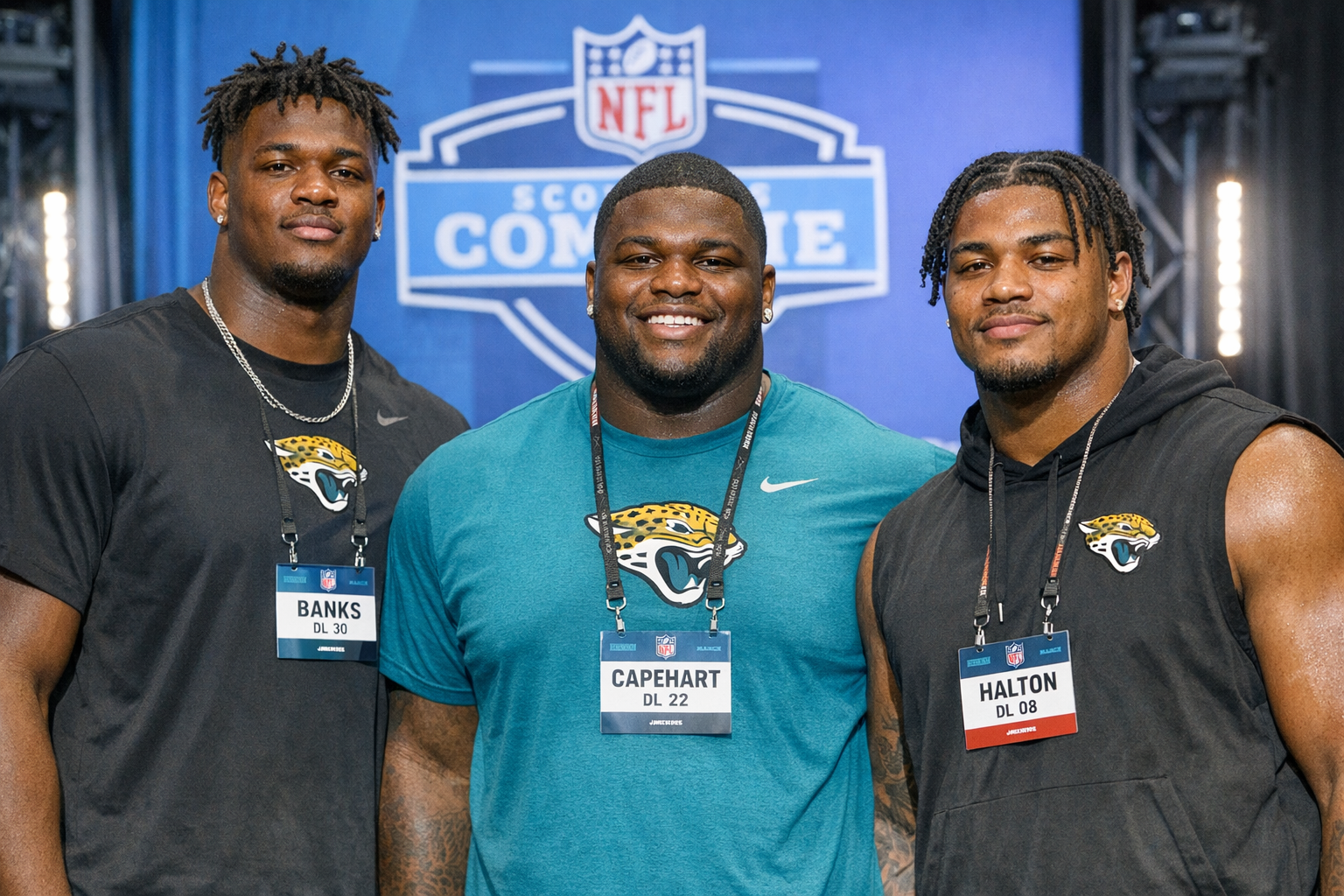
NFL Scouting Combine defensive tackle standouts for the Jacksonville Jaguars
The NFL Scouting Combine is increasingly less central to draft evaluation because fewer athletes choose to complete a full testing slate, and because the testing environment is not controlled in a way that reliably mirrors what happens on the football field. Even with those limitations, the 2026 event still produced enough measurable results for the Jacksonville Jaguars and the staff led by James Gladstone to identify potential standouts at positions of need.
Defensive tackle is one of the positions where combine testing can still be useful, because size, lower-body explosiveness, and short-area acceleration can help confirm whether a prospect’s physical profile matches the role a team wants to fill. The players below stood out in testing, and each profile maps to a different type of defensive tackle solution, from high-end size and explosiveness to rotational run defence and upfield disruption.
What does “defensive tackle” mean in NFL roster building?
A defensive tackle is an interior defensive lineman who aligns inside, typically over or near the offensive guards and centre. Defensive tackles are commonly asked to stop the run by controlling gaps, and they can also affect the passing game by collapsing the pocket from the middle. Teams often look for different sub-types at the position, including a heavier run-stuffer who can anchor against double teams, and a more explosive, upfield defender who can shoot gaps and create pressure.
For Jacksonville, the interior pass rush was a noted issue for long stretches of the season. The Jaguars had an elite run defence, but the interior pressure impact was limited, with Arik Armstead identified as the primary defensive tackle who consistently made an impact as a pass rusher. This context matters because it frames why an athletic, upfield defensive tackle profile can be especially valuable, even if the team already performs well against the run.
Why combine testing still matters for defensive tackles
Combine results do not replace game film, but they can answer narrow questions in a consistent format. For defensive tackles, jumps such as the vertical jump and broad jump are commonly used as indicators of lower-body explosiveness. Sprint splits, including the 10-yard split, can help indicate short-area acceleration, which is relevant for first-step quickness and early movement off the snap.
The practical value is confirmation. If a prospect is unusually large, strong testing can confirm that the player is not only big, but also capable of moving explosively. If a prospect is undersized, strong testing can support a projection that the player can win with quickness and penetration. This leads to more confident role definition, which is a core part of draft decision-making.
Florida defensive lineman Caleb Banks: rare size with explosive jumps
Florida defensive lineman Caleb Banks stood out because his size and explosiveness showed up together in measurable form. Banks weighed 336 pounds, making him one of the biggest defensive tackle prospects in the class, yet he recorded a 32-inch vertical jump and a 9'6" broad jump. Those numbers matter because they indicate lower-body power at a weight that typically limits explosive movement.
From a Jaguars perspective, the discussion is also shaped by draft availability. The view presented is that it seems highly unlikely Jacksonville would be able to land Caleb Banks at No. 56, and it may even be unlikely that the Jaguars could land him in the second round based on how his draft stock is trending. In other words, Banks is framed as an ideal fit in theory but difficult to acquire in practice, which is a common reality when a player combines rare traits with strong pre-draft momentum.
Clemson defensive lineman DeMonte Capehart: rotational run defender with upside
Clemson defensive lineman DeMonte Capehart is presented as a logical target if Jacksonville wants to reinforce the defensive tackle room with a young run-stuffer who also has some explosiveness. Capehart is described as an older prospect who played over 50 games for Clemson, and his projected role is framed as a Day 3 rotational defender who can contribute against the run.
Capehart’s combine testing suggested additional upside beyond a pure early-down run profile. He recorded the fourth-best 40-yard dash time and the third-best vertical jump among all defensive tackles at the event. The expectation stated is that he will not be a top pick, but he is positioned as a name worth tracking deeper into the draft process, particularly for teams that want depth and role-specific reliability without spending premium draft capital.
Oklahoma defensive lineman Gracen Halton: undersized, gap-shooting interior disruptor
Oklahoma defensive lineman Gracen Halton is described as an undersized defensive tackle who thrives by shooting gaps and getting upfield. That style directly connects to what Jacksonville was missing from the interior for large stretches of the season, because the team’s run defence was elite while the interior pass-rush impact was limited outside of Arik Armstead. Halton’s profile fits the idea of adding a defensive tackle who can win with penetration and quickness rather than size and anchoring.
Halton’s testing backed up the athletic projection. He recorded the best vertical jump of any defensive tackle at 36.5 inches, the third-best broad jump, the third-best 40-yard dash time at 4.82 seconds, and the fifth-best 10-yard split. Those results collectively point to lower-body explosiveness and short-area acceleration, which are relevant for a player whose success depends on quick disruption. He is characterised as a high-ceiling option in the draft class, which aligns with the combination of role fit and standout testing.
How these three defensive tackle profiles map to Jaguars needs
These prospects represent three different solutions to a defensive tackle problem, and the differences are useful for decision-making because roster building is about roles, not just names. Caleb Banks represents a rare size-and-explosiveness profile, which can be valuable for teams that want power and movement ability in the same body type, but his availability is described as a major obstacle. DeMonte Capehart represents a rotational run-defence option who also tested well enough to suggest more athletic upside than a typical early-down specialist. Gracen Halton represents the upfield, gap-shooting archetype that directly addresses a stated interior pass-rush limitation.
For Jacksonville, the practical takeaway is that combine testing can help narrow which defensive tackle style best complements an already strong run defence. A team that already stops the run at a high level may prioritise interior disruption, especially if the current roster lacks consistent pass-rush impact from the middle. That does not make a run-stuffer irrelevant, but it does clarify the trade-offs when allocating draft picks.
What changes next in the draft process, and how to use combine results responsibly
After the combine, the evaluation process typically shifts towards role projection and acquisition strategy. The key change is that testing numbers become inputs to film-based questions rather than conclusions. A team can use jumps and sprint splits to validate whether a player’s movement traits match the role the team intends to ask the player to perform.
For decision-making, this leads to a simple discipline. Use combine results to confirm thresholds, such as whether a heavy defensive tackle still shows explosive movement, or whether an undersized defensive tackle has the acceleration to live in the backfield. Then use film and role fit to decide whether that athletic profile translates into consistent production against NFL offensive line play.
Takeaway framework: a simple way to classify defensive tackle targets
A practical way to keep defensive tackle evaluation organised is to classify targets into three buckets based on role and traits:
- Power and size with movement ability: a heavier defensive tackle who still shows explosive traits, useful for teams seeking rare physical profiles.
- Rotational run defence with functional explosiveness: a player projected to contribute on early downs and provide depth, while still offering some athletic upside.
- Upfield disruption and gap penetration: an undersized or lighter defensive tackle who wins with quickness, aiming to create interior pressure and negative plays.
This framework is reusable because it separates what a player is from where a player might be drafted, and it keeps the focus on what the Jaguars actually need the player to do.
FAQ: Jaguars defensive tackle combine standouts
Is the NFL Scouting Combine still useful for evaluating defensive tackles?
The combine can still be useful for defensive tackles because it provides measurable indicators of explosiveness and acceleration, even though fewer athletes test fully and the environment does not replicate on-field play.
Why is interior pass rush important if a team already has an elite run defence?
Interior pass rush matters because pressure up the middle can disrupt a quarterback’s timing and pocket movement, and it can complement edge rushers. The Jaguars were described as having an elite run defence, but limited interior pass-rush impact outside of Arik Armstead.
What made Caleb Banks stand out at the combine?
Caleb Banks stood out because he weighed 336 pounds and still recorded a 32-inch vertical jump and a 9'6" broad jump, indicating explosive lower-body power at a very large size.
What role is DeMonte Capehart projected to play?
DeMonte Capehart is framed as a Day 3 rotational defender against the run. He is also described as having upside based on testing that included the fourth-best 40-yard dash and the third-best vertical jump among defensive tackles.
What were Gracen Halton’s key testing results?
Gracen Halton recorded the best vertical jump among defensive tackles at 36.5 inches, the third-best broad jump, the third-best 40-yard dash at 4.82 seconds, and the fifth-best 10-yard split.