
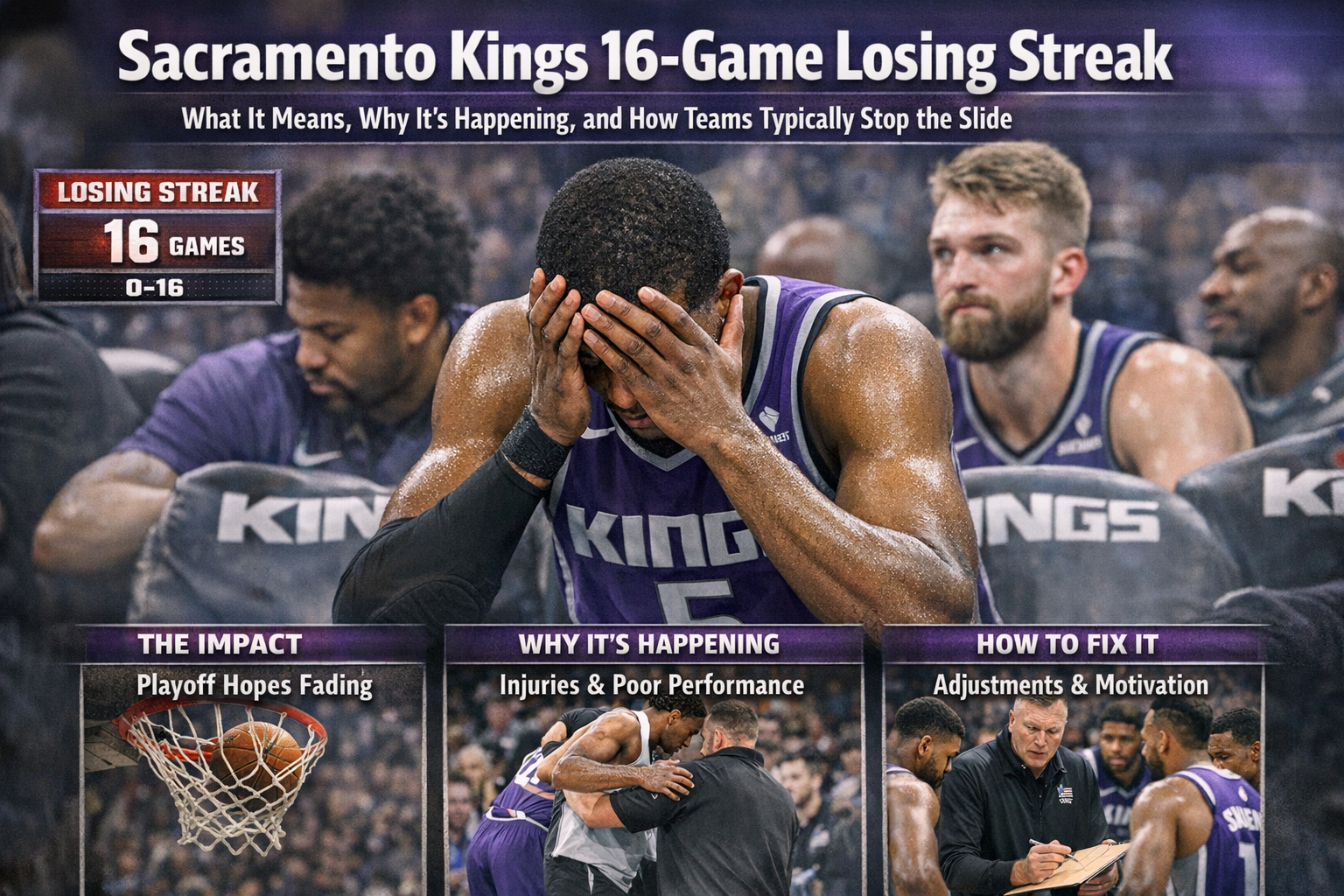
Sacramento Kings 16-game losing streak: what it means and why it matters
If you are trying to make sense of the Sacramento Kings’ 16-game losing streak, the first thing to know is that a run this long changes the conversation. In the NBA, even five or six consecutive defeats can destabilise a team because roles start to feel uncertain and results begin to define confidence. A 16-game streak is long enough to shift from a normal slump into a full crisis, where every game becomes a referendum on roster fit, coaching choices, and the organisation’s direction. That is why scrutiny intensifies with each additional loss, even if individual games are competitive.
A losing streak of this length also matters because it compounds in practical ways. Fatigue becomes harder to manage, not only physically but mentally, because players and staff spend every day reacting to the same outcome. The longer the streak goes on, the more likely it is that late-game execution tightens up, decision-making becomes rushed, and small mistakes turn into decisive opponent runs. This is not a moral judgement about effort. It is a predictable performance pattern that shows up when pressure and uncertainty increase at the same time.
How close are the Kings to the 28-game losing streak benchmark?
The comparison that keeps coming up is the 28-game losing streak recorded by the Detroit Pistons two seasons ago. That Pistons streak became a league-wide reference point because it was so long that it stopped being a team story and became a national storyline, a shorthand for prolonged struggle. Sacramento’s current 16-game losing streak invites that comparison because it is now more than halfway to 28.
Mathematically, the gap is straightforward. Sixteen straight losses means the Kings are 12 losses away from tying 28. In a league where momentum can spiral quickly, that distance can shrink faster than most teams expect, especially when confidence drops and close games start to feel like uphill climbs. The point of the comparison is not that the situations are identical. The point is that long losing streaks create their own gravity, and once a streak becomes historically notable, every next game carries extra psychological weight.
What extended losing streaks do to performance and decision-making
Extended losing streaks tend to affect teams in specific, repeatable ways because pressure changes behaviour. Offensively, players often start pressing, which means forcing shots and possessions that would normally come within the flow of the game. That pressing can look like rushed pull-up jumpers, over-dribbling, or trying to manufacture a highlight play instead of taking the simple option. This leads to lower-quality attempts, more turnovers, and fewer possessions where the defence is put under sustained stress.
Defensively, the same dynamic shows up as magnified mistakes. Small breakdowns that might be survivable in a normal week become decisive because opponents string them together into runs. Communication can drop, rotations become a half-step late, and effort becomes less consistent across four quarters because players are managing frustration as well as fatigue. Coaching decisions also receive heavier second-guessing during a streak, which can create instability in rotations and roles. When roles feel unstable, players tend to play for certainty rather than for the team concept, which is one way a losing streak becomes self-fulfilling.
Why context matters when comparing Sacramento’s streak to Detroit’s
The Detroit Pistons’ 28-game losing streak happened in a context described as rebuilding. The Pistons were leaning heavily on a young core expected to develop through adversity, and the broader framing was about draft capital, youth development, and patience. Even while losses mounted, that context allowed the organisation to point to growth milestones and sell a long-term direction, however painful the short term felt.
Sacramento’s situation is described differently in the source material. The Kings are also transitioning, but the roster is framed as being built more around veterans who do not seamlessly complement one another, rather than around a clearly defined young nucleus being developed for the future. That distinction changes how a 16-game losing streak is perceived. A young team can often absorb losses under the banner of development, where mistakes are treated as learning. A veteran-leaning group without an obvious pipeline of emerging, high-upside talent tends to face sharper scrutiny because the question becomes immediate: what is the plan, and how does this group fit a coherent identity?
What the streak signals about roster construction and team identity
When a team loses 16 straight, the conversation naturally expands beyond box scores. Questions arise about roster construction, front office direction, and whether the pieces fit a cohesive identity. Those questions become louder when the team is described as caught between timelines, neither fully rebuilding nor fully contending. In that middle ground, it is harder to explain losses as the cost of development, and it is also harder to justify them as a short-term blip on the path to contention.
A clear team identity acts as a stabiliser during bad stretches because it gives players a shared decision framework. Without that identity, every game can feel like a new experiment, and experiments feel worse when they happen inside a losing streak. This leads to frustration because there is no obvious timeline for improvement. The problem is not simply that the team is losing. The problem is that losing without a clear developmental core or a clear contention pathway creates uncertainty, and uncertainty tends to show up as inconsistent execution.
The psychological sustainability problem: why veteran teams can feel it more
A key factor in long losing streaks is psychological sustainability, meaning how long a group can keep playing with belief while results remain negative. Young teams often play with more energy and freedom during losing stretches because expectations are modest and mistakes are more easily framed as part of growth. Veteran groups carry a different burden because reputations, contract expectations, and past success create pressure to deliver now.
For the Kings, the source material frames belief as increasingly difficult to maintain as losses stack up. Every close game lost reinforces doubt, and every blowout defeat chips away at confidence. That emotional toll can accelerate a slide in ways that statistics alone do not capture. This is one reason a team can look functional for long stretches of a game and then unravel late. Late-game performance is where doubt is most expensive because hesitation and rushed decisions both lead to low-quality outcomes.
What teams typically do to stop a losing streak before it becomes historic
A 16-game losing streak is a warning sign, but it still leaves space for intervention. In practical terms, teams typically try to stop a slide by reducing complexity and restoring role clarity. That often means narrowing rotations, simplifying offensive decision rules, and prioritising defensive assignments that players can execute consistently. The goal is not to invent a new system overnight. The goal is to create a stable baseline where the team can win a single game, because one win changes the emotional environment and reduces the feeling that losing is inevitable.
Teams also look for cohesion, which is the alignment between what the coaching staff asks for and what the roster can reliably do under pressure. If the roster does not complement itself, the fastest path to improvement is usually not a dramatic overhaul mid-streak. It is a series of smaller adjustments that reduce conflicting skill sets on the floor at the same time. When a team is described as needing a reshaping of identity, the immediate question becomes whether that identity can be clarified quickly enough to stop the streak, or whether deeper structural decisions are required.
What happens next if the streak continues
If the Kings’ losing streak continues, the risk is that the expectation of losing seeps into late-game execution. That expectation changes how players make decisions because they start playing to avoid mistakes rather than to create advantages. This leads to tighter shooting, slower reads, and more possessions that end without forcing the defence to rotate. It also increases the chance of internal instability, because pressure tends to amplify disagreements about roles, rotations, and priorities.
If the Kings break the streak soon, the immediate benefit is not only one win in the standings. The bigger benefit is psychological relief, which can restore normal decision-making and reduce pressing. The longer the streak lasts, the more each game feels like a referendum on the entire project. That is why the next phase depends on swift adjustments, renewed cohesion, and clarity about what the team is trying to be on both ends of the floor.
Takeaway framework: how to interpret a 16-game losing streak without guessing
A simple way to interpret a 16-game losing streak is to separate three questions that often get blended together.
- Performance: What is breaking down on the court that turns small mistakes into opponent runs?
- Structure: Do roles, rotations, and line-ups create consistency, or do they create uncertainty?
- Direction: Is the team developing a clear young core, pushing to contend, or stuck between timelines?
This framework keeps the analysis grounded. It also explains why comparisons to a 28-game losing streak appear once a team reaches 16 losses in a row. The number is a warning, but context determines what the warning actually means.
FAQ
How many games have the Sacramento Kings lost in a row?
The source material states that the Sacramento Kings are on a 16-game losing streak.
How close is a 16-game losing streak to the 28-game streak by the Detroit Pistons?
A 16-game losing streak is 12 losses away from tying 28.
Why do long losing streaks get worse over time?
Long losing streaks can worsen because mental wear and tear increases, players press offensively, defensive mistakes compound, and role instability can develop through heavier second-guessing of coaching decisions.
Why is the Kings’ situation compared differently to the Pistons’ 28-game streak?
The source material describes the Pistons’ streak as occurring during a rebuilding phase centred on youth development and patience, while the Kings are described as transitioning with a roster built more around veterans who do not seamlessly complement one another.
What is the main risk if the Kings do not break the streak soon?
The main risk described is that losing becomes self-fulfilling, with the expectation of defeat affecting late-game execution and confidence.